
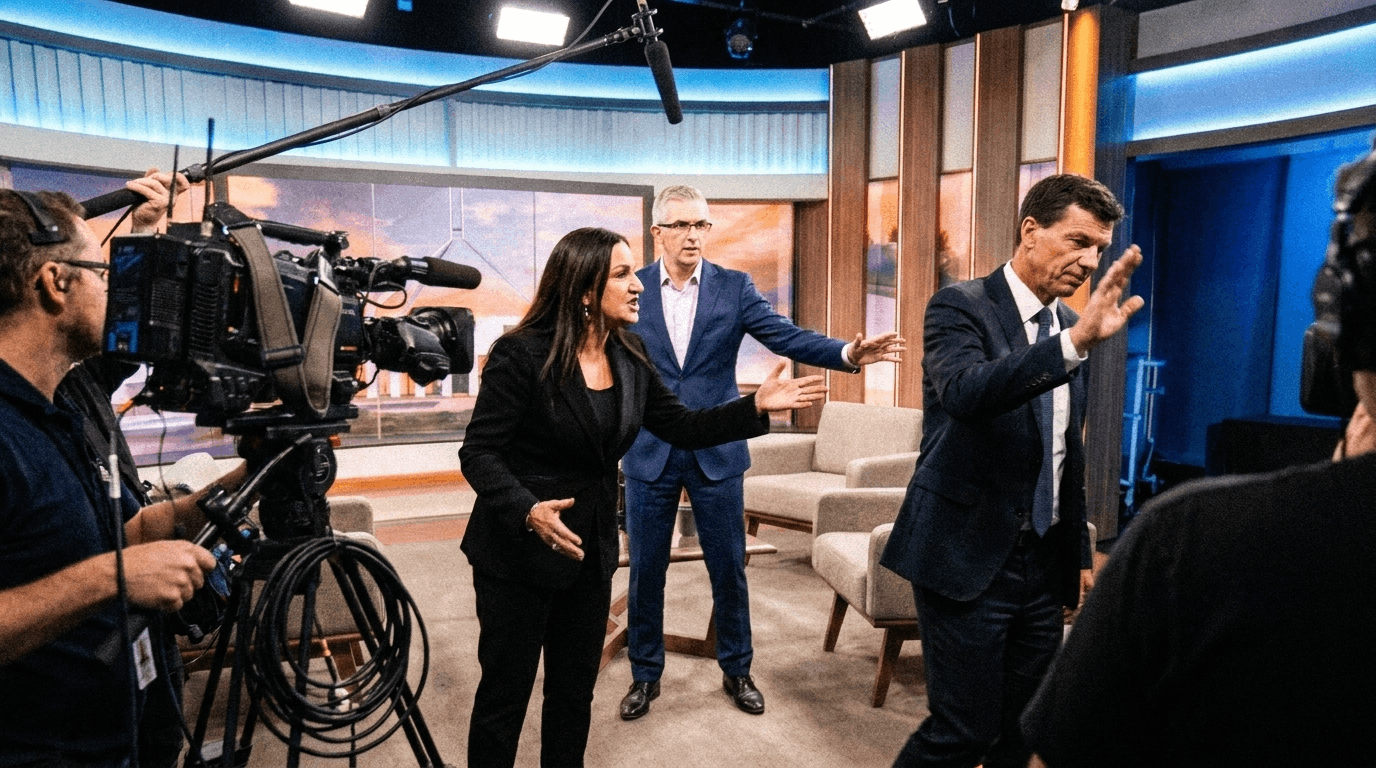
Jacqui Lambie & Angus Taylor Suddenly Found Themselves on the Same Side — And Canberra Noticed
Jacqui Lambie and Angus Taylor are not the most obvious political partnership in Canberra.
Advertisement
One is an outspoken independent senator from Tasmania who has spent years attacking both major parties when she believes they have failed ordinary Australians.
The other is the leader of the Liberal Party and the man attempting to convince voters that the Coalition is ready to govern again.
They have different political histories, different styles and plenty they could disagree about.
But something unusual has happened in recent weeks.
On two of the most emotionally charged issues in Australian politics, Lambie and Taylor have suddenly found themselves standing on remarkably similar ground.
And it started with Australia’s veterans.
It Began With an Attack That Crossed a Line
The controversy erupted after One Nation published an animated video repeatedly describing Liberal frontbencher Andrew Hastie as a “traitor”.
Hastie is not simply another politician.
Before entering parliament, he served as an officer in Australia’s Special Air Service Regiment and deployed to Afghanistan.
The One Nation video referred to his involvement as a witness in the Ben Roberts-Smith defamation proceedings.
The political reaction was immediate.
But few responded as forcefully as Jacqui Lambie.
“What she’s doing in those cartoons is absolutely disgusting,” Lambie told ABC Radio National.
She went considerably further, describing Pauline Hanson as a “bloody coward” and delivering a blunt message:
“Leave our veterans alone.”
For anyone familiar with Lambie’s political career, the intensity was hardly surprising.
She served in the Australian Army herself.
Veterans’ affairs have remained one of the defining issues of her time in Parliament.
But what happened next was more interesting.
Angus Taylor Stepped In Too
Taylor did not adopt Lambie’s language.
His response was much more controlled.
But his conclusion was essentially the same.
The Opposition Leader publicly defended Hastie’s military service and called on Hanson to remove the cartoon.
“Andrew Hastie has served this country with distinction as an officer in the SAS,” Taylor said.
“She should take it down.”
Suddenly two politicians who would rarely be described as natural allies were sending almost exactly the same message.
Lambie delivered it with fury.
Taylor delivered it with restraint.
But neither was prepared to accept the attack on Hastie.
And That Wasn’t the Only Issue Bringing Them Together
Behind the political drama surrounding One Nation, another battle had been developing.
This one was about money.
The Albanese government had proposed imposing a $5,000 annual limit on allied health services for veterans, covering treatment such as physiotherapy and dentistry, although additional funding could have been available where clinical need was demonstrated.
The government expected the measure to save roughly $750 million over three years.
Veterans’ organisations were furious.
So was Jacqui Lambie.
And for Lambie, this fight became extraordinarily personal.
Lambie Revealed What Few Australians Knew
In August, Lambie stood in the Senate and publicly discussed serious health problems she linked to injuries sustained during her military service.
She had undergone surgery and said she had paid thousands of dollars herself rather than wait for treatment through the veterans’ system.
It was one of the most personal speeches she had delivered in Parliament.
But Lambie wasn’t revealing those details simply to tell Australians what had happened to her.
She was trying to demonstrate what she believed could happen to other veterans if access to treatment became more difficult.
The $5,000 cap became her target.
And she refused to let the issue disappear.
Then Angus Taylor’s Coalition Joined the Pressure
The Coalition also opposed the government’s proposal.
That created an unusual political alignment.
Veterans’ groups were campaigning against the cap.
Lambie was attacking it from the crossbench.
And Taylor’s opposition was putting pressure on Labor from the other side of Parliament.
For once, the argument wasn’t primarily between left and right.
The pressure was coming from several directions simultaneously.
Then, on September 17, the government backed down.
The proposed cap was scrapped.
Lambie’s reaction was exactly what Australians who have followed her career might expect.
“The bloody cap has been scrapped.”
She celebrated the decision as a victory for veterans.
Taylor, meanwhile, turned his attention toward the government.
Taylor Wanted Someone Held Responsible
The Opposition Leader did not simply welcome the reversal.
He attacked Veterans’ Affairs Minister Matt Keogh over the handling of the proposal and called on Prime Minister Anthony Albanese to remove him from the portfolio.
Again, the styles were different.
Lambie celebrated the policy victory.
Taylor attempted to turn the reversal into a question about government competence.
But the political destination was remarkably similar.
Both had opposed the policy.
Both had demanded change.
And the government had changed course.
Something Interesting Is Happening on the Conservative Side of Politics
There is another reason the Lambie-Taylor overlap matters.
One Nation is becoming increasingly important to Australian politics.
And both Lambie and Taylor have reasons to confront it.
For Taylor, Pauline Hanson’s party represents direct competition for conservative voters.
The Liberal leader therefore faces a delicate problem.
He needs to demonstrate that his party understands voters who have become frustrated with mainstream politics without simply adopting One Nation’s positions.
Lambie’s relationship with Hanson is completely different.
She does not lead a major centre-right party competing nationally with One Nation.
But she has become increasingly willing to confront Hanson directly — particularly when veterans are involved.
Their motivations may therefore be different.
The result can occasionally look surprisingly similar.
Don’t Call Them Political Allies Yet
This is where the story needs some perspective.
There is no new Lambie-Taylor political alliance.
There has been no announcement of a formal partnership.
And nobody should expect Jacqui Lambie to suddenly begin following the Liberal Party line.
That would be deeply inconsistent with the political identity she has built.
Likewise, Taylor is attempting to lead the Coalition back into government, not assemble an informal partnership with independent senators.
But politics sometimes produces alliances without anyone actually becoming allies.
An issue appears.
Two politicians look at it from different directions.
And suddenly they discover they are standing in almost exactly the same place.
That is what has happened here.
Lambie Has Something Taylor Cannot Easily Replicate
When Lambie talks about veterans, she brings a personal history that few federal politicians possess.
She served in uniform.
She has publicly discussed the physical consequences she says followed that service.
And she has repeatedly made veterans’ affairs central to her political identity.
That gives her interventions a different character.
Taylor, however, has something Lambie does not.
He leads the opposition.
When both voices begin pushing in the same direction, the political pressure can therefore become considerably harder for a government to ignore.
The veterans’ health controversy demonstrated exactly that.
Then Came the Result
The government initially defended its approach.
Veterans kept objecting.
Lambie kept talking.
The Coalition kept applying pressure.
And eventually the proposal disappeared.
Veterans’ Affairs Minister Matt Keogh said consultation had made clear that the measure was causing concern and that the government had listened.
For Lambie, it was vindication.
For Taylor, it was another opportunity to attack Labor.
For veterans, the political motivations probably mattered considerably less than the result.
Canberra’s Most Unexpected Agreement?
Perhaps that is what makes the past few weeks so interesting.
Lambie and Taylor haven’t suddenly become friends.
They haven’t formed an alliance.
And there is no secret deal behind what Australians have been watching.
The reality is simpler — and arguably more interesting.
Two very different political figures encountered issues on which neither was prepared to move.
First came the defence of Andrew Hastie and Australia’s veterans against an attack they both believed had gone too far.
Then came the battle over veterans’ health care.
Lambie brought the anger.
Taylor brought the weight of the opposition.
And on the second issue, the government eventually retreated.
This May Not Be the Last Time
Australian politics is becoming increasingly fragmented.
Labor governs.
Taylor is attempting to rebuild the Coalition.
One Nation is fighting for a larger share of the conservative vote.
And independents such as Lambie can become crucial when legislation reaches the Senate.
That means strange political combinations are likely to become more common.
Lambie and Taylor will undoubtedly disagree again.
Probably loudly.
But September has demonstrated something worth remembering.
When an issue involving Australia’s veterans reaches Parliament, party labels can suddenly become much less important.
And for a few remarkable weeks, Jacqui Lambie and Angus Taylor — two politicians with very different approaches to Canberra — discovered that they were fighting some of the same battles.
Neither planned the partnership.
Neither has called it one.
But Canberra certainly noticed.

